Amongst the rare and riches lining the wall of a bar, there sits a toad. And the toad, in turn, faces an uncertain face looking back. It thinks: There sits a challenge. How does a toad convince a more reluctant audience to find out what we already know? It's smoother than you expect.
Amongst the rare and riches lining the wall of a bar, there sits a toad. And the toad, in turn, faces an uncertain face looking back. It thinks: There sits a challenge. How does a toad convince a more reluctant audience to find out what we already know? It's smoother than you expect.
The operative word is: Expectation.
This was a true passion project to test our Li/o model. We bought drinks for 20 individuals asked to answer a survey in their own words.*
There was a significant disconnect between how people perceive Natterjack before trying it versus how they feel after their first sip. Clear biases worked against initial trial, but the actual tasting experience moved the dial considerably.
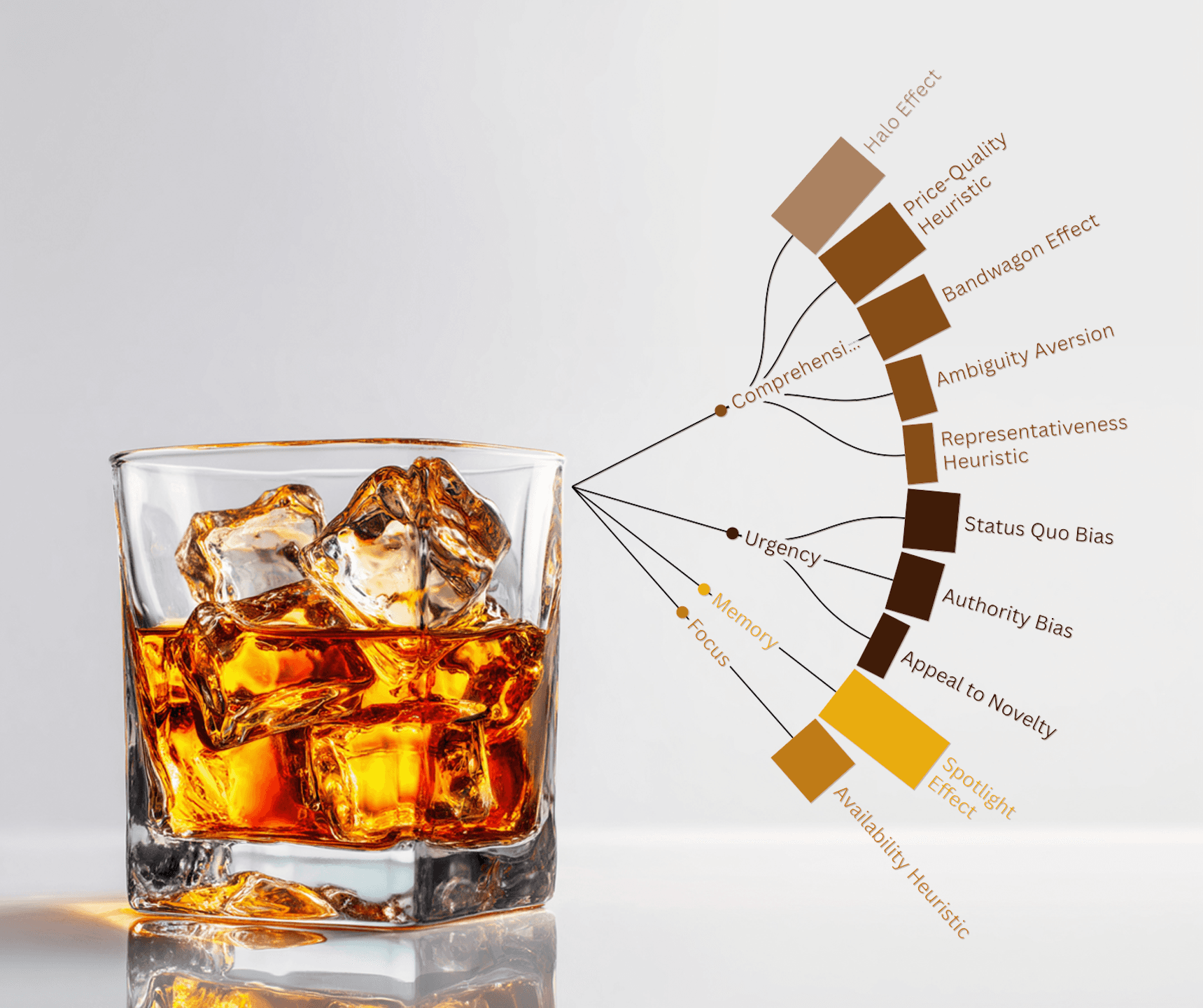
Let’s start with smooth, a winning characteristic for the brand. For many, the taste triggered a price-quality heuristic; because it was so easy to drink: they assumed it was an expensive, high-end whiskey. We also saw loss aversion in real-time, where the relief of it not being "harsh" led participants to immediately commit to a second pour. Essentially, the liquid confirms the brand’s quality, with one participant even noting it felt "top shelf."
The real challenge uncovered by our model was the initial reticence to try it. Before tasting, several participants relied on status quo biases—claiming they wanted to "keep it light" or usually avoid "heavy" spirits. There was also a notable negative novelty bias, where the product’s unique look made people worry it would be "too much" for them. While social pressures like the bandwagon or spotlight effects got people to say yes, this can be risky because they can make the consumer feel pressured, which may color their long-term view of the brand.
So while this was a small sample of 20 people, the results were definitive. We need to look beyond smooth in our communications. To actually drive trial, we must actively challenge the expectations people have about the category and brand before they even pick up the glass.
*These insights were built on a survey analysis by our model Li/o.v3

The operative word is: Expectation.
This was a true passion project to test our Li/o model. We bought drinks for 20 individuals asked to answer a survey in their own words.*
There was a significant disconnect between how people perceive Natterjack before trying it versus how they feel after their first sip. Clear biases worked against initial trial, but the actual tasting experience moved the dial considerably.
Let’s start with smooth, a winning characteristic for the brand. For many, the taste triggered a price-quality heuristic; because it was so easy to drink: they assumed it was an expensive, high-end whiskey. We also saw loss aversion in real-time, where the relief of it not being "harsh" led participants to immediately commit to a second pour. Essentially, the liquid confirms the brand’s quality, with one participant even noting it felt "top shelf."
The real challenge uncovered by our model was the initial reticence to try it. Before tasting, several participants relied on status quo biases—claiming they wanted to "keep it light" or usually avoid "heavy" spirits. There was also a notable negative novelty bias, where the product’s unique look made people worry it would be "too much" for them. While social pressures like the bandwagon or spotlight effects got people to say yes, this can be risky because they can make the consumer feel pressured, which may color their long-term view of the brand.
So while this was a small sample of 20 people, the results were definitive. We need to look beyond smooth in our communications. To actually drive trial, we must actively challenge the expectations people have about the category and brand before they even pick up the glass.
*These insights were built on a survey analysis by our model Li/o.v3
The operative word is: Expectation.
This was a true passion project to test our Li/o model. We bought drinks for 20 individuals asked to answer a survey in their own words.*
There was a significant disconnect between how people perceive Natterjack before trying it versus how they feel after their first sip. Clear biases worked against initial trial, but the actual tasting experience moved the dial considerably.
Let’s start with smooth, a winning characteristic for the brand. For many, the taste triggered a price-quality heuristic; because it was so easy to drink: they assumed it was an expensive, high-end whiskey. We also saw loss aversion in real-time, where the relief of it not being "harsh" led participants to immediately commit to a second pour. Essentially, the liquid confirms the brand’s quality, with one participant even noting it felt "top shelf."
The real challenge uncovered by our model was the initial reticence to try it. Before tasting, several participants relied on status quo biases—claiming they wanted to "keep it light" or usually avoid "heavy" spirits. There was also a notable negative novelty bias, where the product’s unique look made people worry it would be "too much" for them. While social pressures like the bandwagon or spotlight effects got people to say yes, this can be risky because they can make the consumer feel pressured, which may color their long-term view of the brand.
So while this was a small sample of 20 people, the results were definitive. We need to look beyond smooth in our communications. To actually drive trial, we must actively challenge the expectations people have about the category and brand before they even pick up the glass.
*These insights were built on a survey analysis by our model Li/o.v3
2937 E Grand Blvd,
Detroit, MI 48202
hello@FarleyOil.com
Stories
2937 E Grand Blvd,
Detroit, MI 48202
hello@FarleyOil.com
Stories
2937 E Grand Blvd,
Detroit, MI 48202
hello@FarleyOil.com
Stories